
SECURITY PLAN
Security Plan
Overview & Contacts
The Team Race World Championships 2026 will feature approximately 12 international teams with boats provided by the organizer. The goal is to deliver a safe and secure experience for all participants. To achieve this, all participating coach and support boats, and the volunteers on land, will be part of the safety organization. Please read this document carefully before you head out to sea.
112 — General Emergency
Call 112 immediately for Police, Ambulance, Rescue Service/Fire Brigade, or Maritime Rescue. The first person to see an emergency or serious accident must call 112 right away — no need to consult the safety manager or anyone else in the safety organization first.
But please also notify the safety manager or another part of the organisation once the call is made. After the incident, the safety manager and the Race Director / Chief Medical Officer handle all communication with relatives, media, etc.
When you call, you will be asked for an address — give: Norr Mälarstrand 31, Stockholm.
Security Officer
The security manager for the event is Erik Björling, +46 70-520 45 55. The security manager has contacts with all parts of the organization that may be involved in the event of an accident, healthcare, etc.
The professional night guard is Fredrik Lindgren, fli@scutus.se, +46 70-426 21 75.
Chief Medical Officer (Fleet Surgeon)
GSYS has a medical officer on site, Christer Svensén, +46 70-609 57 63, who is on the quay during the morning and late afternoon. During the day, the medical doctor is on the water.
The Chief Medical Officer carries an emergency bag with appropriate emergency drugs and a defibrillator.
Radios and Communications
We mainly work with VHF for external communication and UHF for regatta communication. UHF channel 1 is used by all participants for communication between officials and the sailing boats. If that doesn’t work for some reason, we use mobile phones.
First Aid Kits
First aid kits are carried on the Safety vessel, the Regatta Expedition, and the GSYS safety boats. Every racing boat also carries a small first aid kit and a safety card.
Security and Participation Reporting
To increase safety for participants during the regatta, boats that deviate from normal transportation to and from the course area must report this to race management. The following applies:
- When a participant decides not to sail out to the course area, or an individual boat leaves the course area outside the normal entry/exit window before or after the day’s sailing, they must report this to race management as soon as possible.
The report is made by the participant themselves, or by asking an official, via UHF channel 1, to the Race Officer, stating why the boat is leaving the course area.
Gathering Place on the Water
If several sailors end up in the water at once, the start and finish ships are the collection points. Safety always comes before property.
Meeting Point for Ambulance
Norr Mälarstrand Quay 31, Stockholm.
AED — Defibrillator
Available at the restaurant The Dock and the GSYS regatta office, with people trained in their use. The medical doctor also carries a mobile AED on the water during the day.
Pharmacy
Nearest: Kronans Apotek, Scheelegatan 1, 077-161 26 12. Open 24/7: Apoteket C.W. Scheele, Klarabergsgatan 64.
Healthcare Information
General healthcare advice — Vårdguiden: 1177
Nearest Hospital
St Görans Hospital — on the same island as the regatta, Sankt Göransgatan 139, +46 8-5870 10 00.
Intensive Care Unit Solna — Karolinska University Hospital, Anna Steckséns gata 33, C4:27, Solna.
Medical Quick Guide
Quick guide for officials in the event of an accident.
What Do I Do While I Wait?
Basic Life Support (BLS) is the modern name for what used to be called ABC care, where A stands for Airway/Breathing, B for Bleeding, and C for Shock.

International signal for help
A — Breathing: Call for Help
When an accident happens, it’s easy to focus on what you see — blood, and stopping the bleeding. But there is no point doing anything about that if the victim is not breathing. Breathing always comes first. To check whether the injured person is breathing, remember: look, listen, feel. Lean your ear towards the mouth, look towards the chest, and listen and feel for breathing.
One of the most common reasons for not breathing is an obstruction in the airway. First feel in the mouth for anything blocking it, and try to open the airway. You can also loosen tight clothing. One way to clear the airway is to gently lift the lower jaw. Once you’ve established that the injured person is breathing, place them in a stable side position (recovery position), and keep checking that they are still breathing. If you feel unsure, you can always get instructions from SOS while you wait for help.
If the injured person is still not breathing even after you’ve cleared the airway, you can try mouth-to-mouth: lift the chin slightly, hold the nose closed, and blow a normal-sized breath, repeating at a calm pace.
Another reason for not breathing is something stuck in the trachea. In that case you can try the Heimlich manoeuvre: stand behind the person, grab them just below the chest, and press firmly — a strong hug from behind. The idea is that the puff of air created pushes out whatever is stuck. For small children, an alternative is to turn them upside down and gently shake out what is stuck.
B — Bleeding: Call for Help
Blood makes up roughly 7% of body weight, and losing 30% of it is life-threatening. Fractures of various kinds are one thing that can cause major blood loss. A distinction is made between external and internal bleeding — internal bleeding is the tricky part, since it isn’t visible. As a layperson there isn’t much you can do here besides calling for help. For external bleeding, try to stop the blood loss as best you can with a pressure bandage or by elevating the injury.
C — Shock: Call for Help
A person goes into shock when the circulating blood volume is too small for the vascular system. This is a life-threatening condition that can be caused by, for example, bleeding, burns, allergies, heart failure or other conditions. Warning signs of shock include a fast, weak pulse (check on the side of the neck), pale skin, cold sweat, signs of anxiety or confusion, thirst, and/or fast, shallow breathing. Left untreated, the condition can lead to unconsciousness and cardiac arrest.
If you suspect someone is going into shock: create a clear airway, place them in a stable side position, raise their legs, and stop or reduce any blood or fluid loss. Do not give the person anything to drink, and do not leave them alone. Call for help immediately.
What Should I Do If I Have a…
Person in the Water
Umpire boats and/or safety boats should quickly approach the person/s in the water, recover them, and check them over. If they’re 100% OK, they can go back to their race boat. If not, bring them back to our dock quickly to be examined by the Chief Medical Officer. Rescuing staff should be ready to return to their normal duties swiftly after the rescue, and should continuously update the Race Director on the status of the case via radio.
There is a 12-knot speed limit in the area, but that does not apply in an emergency.
Near Drowning
The first thing to do for someone who has nearly drowned is ABC care. People who have been in the water are often hypothermic, which is itself a serious condition. Remember: legs should not be down — raise the legs. If possible, get the person out of the water in a lying position. Do everything (including ABC) extremely carefully, as rough handling could trigger cardiac arrest. Once out of the water, prevent further heat loss — for example with dry clothes and normal room temperature. If the person wants something to drink, that’s fine as long as they can drink it themselves.
Burns
The severity of a burn depends on its depth and extent — ABC applies here too. Rinse the burn for a long time with cold water, but not so long that the person starts to shiver. After cooling the injury as much as possible, apply a clean, dry dressing, and change it if it bleeds or oozes.
Fractures
If you suspect a fracture, ABC applies again. As best you can, try to stabilize the injury by splinting something rigid to each side, and keep the injured limb elevated.
Seasickness
Best prevented by being dry, warm and well-fed before heading out to sea. Seasickness tablets can also help — there are several varieties, so it’s a matter of finding what works for you.
Allergy
Signs of an allergic reaction can include: itching, runny mucous membranes, swelling, rash, difficulty breathing, and shock. Ask for allergy medicine and provide ABC care.
The Chief Medical Officer carries injection pens for shock/allergy treatment.
Diabetes
If you suspect someone is unwell due to diabetes, the best thing to do is give the person sugar. If you have honey available, it can help to smear it on the lips, even if the person is unconscious. To find sugar, you can check the person’s pockets, as people with diabetes often carry some with them.
Maps & Race Officers
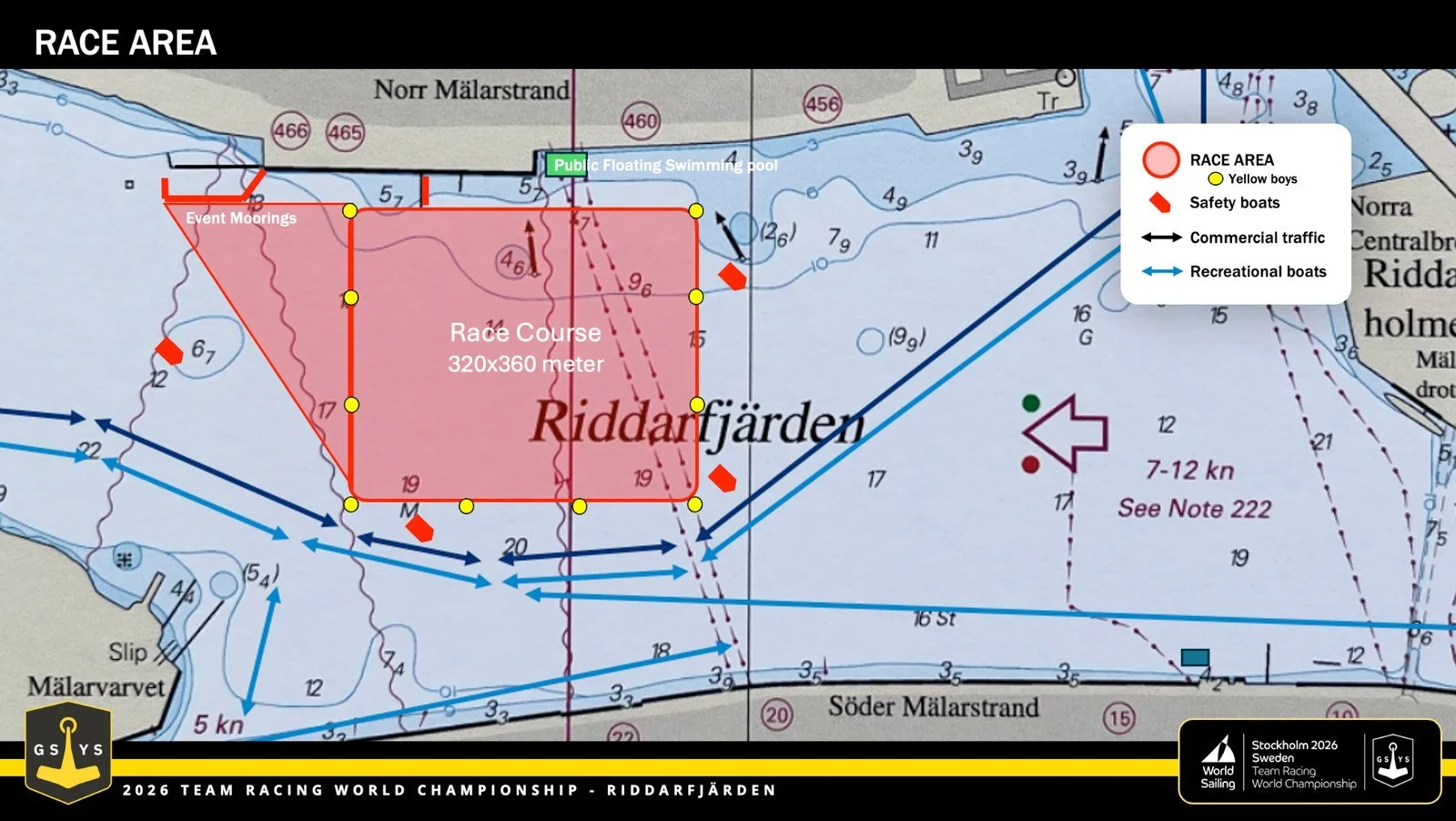
Map of Our Water Area
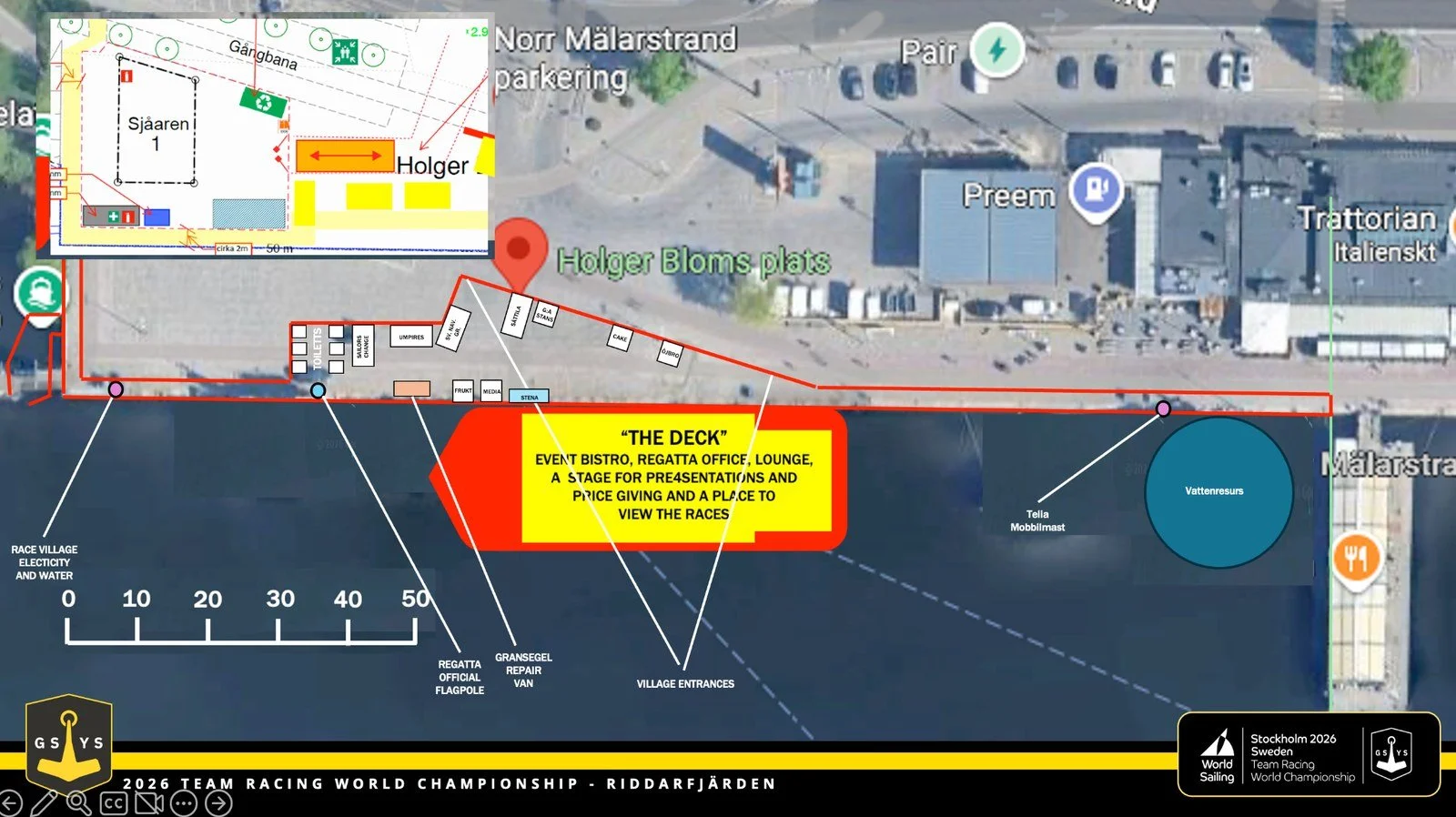
Map of Our Land Area — the Race Village
Sailing Leader
Local Race Officer — Kristina Wiktander Broman, +46 76-859 65 86
International Race Officer — Annika Ekman, +46 70-270 14 44
Radio Channels
Radio Communication via VHF — Marine Radio
| Function | Ch. | Communication With |
|---|---|---|
| START VESSEL | UHF1 | Sailors |
| UHF2 | Change Boats | |
| UHF6 | Manual Course Laying | |
| VHF16 | Outbound | |
| FINISHING VESSEL | UHF1 | Listening |
| UHF9 | Course change / move vessel | |
| SAILORS | UHF1 | Listening + report damage & injuries |
| UMPIRES | UHF3 | Internal |
| UHF4 | Internal | |
| UHF5 | Internal | |
| CHANGE BOATS | UHF2 | Communication with Start Vessel |
| COURSE LAYING, MANUAL | UHF6 | Communication with Start Vessel |
| SECURITY BOATS | UHF1 | Listening |
| UHF8 | Group Communication | |
| VHF16 | Outbound | |
| WS TECHNICAL DELEGATE | UHF1 | Listening; talks with Start Vessel live on the water |
| BOSUN / REPAIR BOAT | UHF1 | Listening and talk to Start Vessel / Umpire |
| MEDICAL / EMERGENCY | VHF16 | Listening to Start Vessel & Security |
VHF16 is the shared outbound / emergency channel — monitored by Start Vessel, Security Boats and Medical/Emergency.
Radio Communication via UHF — Walkie-Talkies
Channel 1 for all participants.
Threat Analysis & Security
Threat Analysis for the Event
The World Championship Race Village may attract 5,000–20,000 visitors or passers-by per day at Norr Mälarstrand. The same weekend, the City of Stockholm is also hosting the Stockholm Culture Festival 2026, which could draw up to several hundred thousand visitors per day.
The festival often runs films nearby in Rålambshovsparken in the evenings, which can attract tens of thousands of visitors — mostly teenagers — who leave via public transport. Most will most likely leave around midnight through Fridhemsplan, some distance from us, but some will likely walk back towards the city or Stockholm Central Station (regional trains) through the Race Village on Norr Mälarstrand. A portion of that crowd could be hostile, or include thieves or others directing aggression at our event or Race Village during the night, estimated between 24:00–03:00.
Security of the Race Village
Due to a limited budget, we have secured volunteers from the GSYS club to wear security vests during daytime (07:00–19:00) and to circulate around the Race Village. Their duties are, first, to be friendly hosts and guide people to the right place, and second, to be visible and stay alert. They are not expected to intervene in any aggression beyond dialogue — they should contact the security manager or call the police directly whenever needed. Stockholm’s main police station is very close by, approximately 600 metres away.
During night-time (19:00–07:00), we have contracted one professional security guard (väktare) from Scutus Protection AB to guard the premises.
Instructions for the Day-Time Land Guards
Visibility is key — wear the security vest and circulate around the village, either in pairs or spread out to cover a larger area. Stay alert and watch for any threats or unusual behaviour. If you notice anything odd, approach the person in pairs and ask what they are doing, if you feel safe doing so — or contact the security manager, who can look into the situation. If the situation feels hostile, contact the police via 112.
Instructions for the Day-Time On-the-Water Guards
Visibility is key — cruise around our closed area of water, with some boats close by and some further out. If a vessel is heading towards our race area, try to block it by positioning your boat between it and the race area. Approach smaller craft — canoes, kayaks, SUPs — and inform them about the closed area; larger vessels can be called on VHF channel 16 and told about the closed area, and asked to pass us on the south side. Signalling or waving your arms usually works well. If a boat comes very close to, or into, our race area, contact the Race Director via VHF — racing must be stopped immediately.
If any situation feels hostile, contact the security officer and/or the police via 112.
Instructions for the Night-Time Guards
Same as above, plus: stroll around the Race Village at intervals of your choosing, preferably every 30–60 minutes. 19:00–02:00 is likely to be the period with the most activity and people; 02:00–07:00 should be quiet.
Approach anyone who seems out of place and ask why they are there — the race day is over by night-time. Some people will naturally belong to the restaurant, and more than 50 volunteers are helping out with the event.
Code word: “Bay of Biscay”
Only staff know this code word. The night guard can ask people for it whenever needed, to confirm they are part of the team.
Order of Interception
- Act on your own initiative, with your own safety in mind.
- Contact the security manager, Erik — he will be sleeping on the finish line ship for the entire event and is available 24/7. Erik is a certified security officer / close protection operative.
- Contact any resources within your security company, or call the police on 112.
The night guard will have a space to sit and rest, with electrical power and a microwave. Mobile toilets will be available in the Race Village.