
Sustainability takes centre stage as sailing looks beyond the racecourse
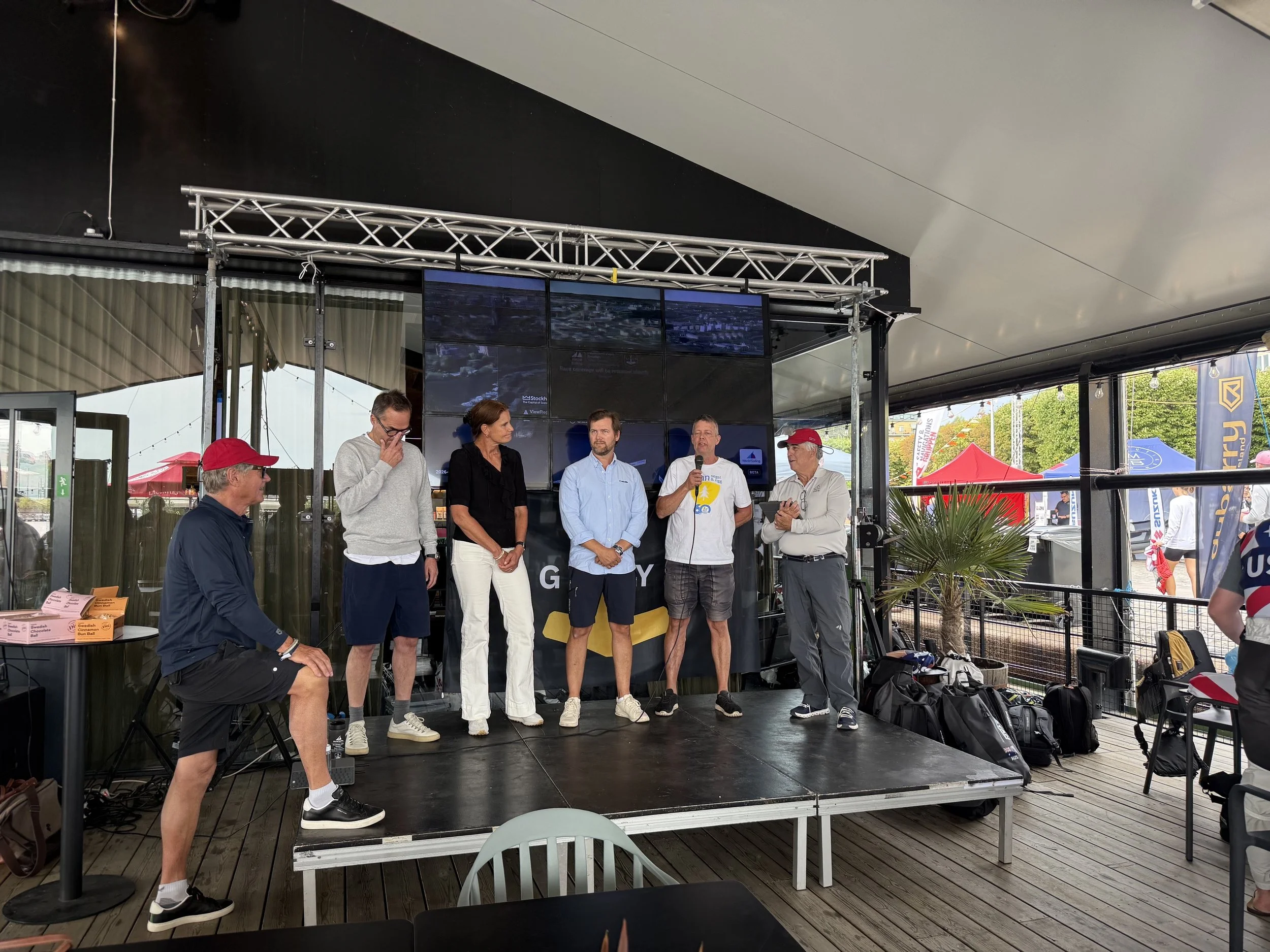
From food waste and recyclable sails to electric boats and World Sailing’s Clean Regattas standard, sustainability was firmly in focus at today’s World Championship Stage in Stockholm.
What does it take to make a sailing event more sustainable and how can the sport itself help drive wider change?
Those questions were at the heart of today’s sustainability seminar at the Race Village on Norr Mälarstrand. The sessions formed part of the Team Racing World Championship’s ambition to achieve World Sailing Clean Regattas Platinum certification, with sustainability integrated into the organisation of the event from the outset.
Small changes can have a big impact
The session among other things focused on sustainable food at major sporting events, with Kristina Ossmark, Marketing Director at Martin & Servera, highlighting how relatively simple choices can significantly reduce the environmental footprint of catering.
Eating more plant-based food, reducing food waste and making more sustainable choices all contribute. As Kristina Ossmark put it, “the best food is the food that ends up in your stomach.”
The message was also that change does not necessarily require one dramatic intervention. Small steps, multiplied across large events, can make a substantial difference and major sporting events have an opportunity to start conversations that continue long after the competition is over.
Making sailing equipment last longer
The discussion then moved to materials and longevity, with Gransegel and Seldén looking at how sails, rigs and components can have a longer life.
Anders Teiner, CEO at Gransegel explained that sails are routinely repaired rather than replaced, while sails that can no longer be used for sailing can be given a second life. Old sails are, for example, transformed into products such as bags and boxes.
Andreas Landahl, Sales Manager at Seldén highlighted the potential for greater circularity in aluminium masts. In an ideal world, aluminium masts can be fully recyclable, but making that happen at scale remains a question of whether customers are prepared to pay for more sustainable solutions.
“We need to scale up”
Electrification was another key theme, with Rene Hansen, CEO at X Shore, discussing the opportunities and challenges of moving from fossil-fuelled boats to electric propulsion.
One of the challenges is simply awareness. Many people still do not know enough about what electric boats can do, or what infrastructure is needed to make them practical. Access to charging is particularly important for sailing clubs and event organisers.
The Team Racing World Championship itself provides a useful illustration of both the potential and the challenge.
Seventeen boats are being used in connection with the regatta, of which 12 could potentially be electric. At present, only four are. The reason is simple: there were not enough electric boats available.
For electrification to become a realistic part of large sailing events, the technology and infrastructure need to scale up.
Clean Regattas: “Everyone can do something”
Steven Wolff, World Sailing Technical Delegate, explained the importance of the Clean Regattas framework. World Sailing requires events to work towards the standard, creating a common approach that can be applied across countries and continents.
One of its strengths is precisely that it is standardised: organisers around the world can use the same framework, while recognising that every event will have different circumstances and opportunities.
Sailors themselves are also an essential part of making the system work.
And the partnership with Stena Recycling at the Stockholm championship sends an important signal, Wolff noted: sustainability needs to be embedded in the practical organisation of an event, not simply discussed as an ambition.
Sustainability was part of the brief from day one
For Magnus Myrenberg, project leader for the Team Racing World Championship, sustainability was never an optional addition.
The event could not enter into its agreement with World Sailing without taking sustainability seriously. The organising team therefore decided early on to aim for Platinum certification, with the ambition of meeting 19 of the 20 criterias.
That ambition is reflected throughout the Race Village, from waste sorting and refill stations to reduce single-use plastics and the use of electric boats.
From Stockholm to the wider sailing world
The sessions were deliberately held in English and opened to the public, with the aim of making the lessons from Stockholm relevant beyond the championship itself.
The underlying message from the afternoon was clear: sustainable sailing is not one technology, one material or one initiative. It is a combination of hundreds of decisions, from what is served on the plate to how boats are powered, how equipment is repaired and what happens to it when it reaches the end of its life.
And major international events have a unique opportunity to demonstrate what is possible.
As the racing continues on Riddarfjärden, the discussion in the Race Village is about how to make sure the sport's environmental ambitions continue long after the final race is over.